Insights
Which media and review websites does AI cite most?

Imagine you run a business. A buyer you do not know yet opens an AI chat (ChatGPT, Gemini, Claude) and asks it to name a few companies in your category. A minute later the potential client has a short list. You may not be on it, or you may be on it with a description you never wrote.
Data as of October 2026.
How often do people ask AI before they buy?
People turn to AI more and more often before they buy something or book a service. According to Product.ai (US, 1,493 adults, August to September 2026), 41.5% of people who shop online used an AI assistant to research a product in the past three months. According to BrightLocal (US, 1,002 adults, March 2026), 45% of consumers use AI to find recommendations for local businesses and services. Among buyers of business software, G2 (1,076 buyers, March 2026) found that 51% start their search in an AI chat more often than in Google. The table below sets out these and other 2026 surveys.
| Area | Survey | Sample and date | Finding |
|---|---|---|---|
| Products | Product.ai | US, 1,493 adults, August to September 2026 | 41.5% of people who shop online used an AI assistant to research a product in the past three months |
| Products | L.E.K. Consulting | US, April 2026 | About 30% of consumers used AI when deciding on a purchase; 46% of AI users start their search in an AI service (25% in 2024) |
| Local services | BrightLocal | US, 1,002 adults, March 2026 | 45% of consumers use AI to find recommendations for local businesses and services |
| Doctors | rater8, as reported by eMarketer | US, 992 adults, April 2026 | 36% said AI influenced their choice of doctor (17% a year earlier) |
| Business software | G2 | 1,076 buyers, March 2026 | 51% start their search in an AI chat more often than in Google (29% in 2025, per G2’s summary); 69% chose a different company after a chatbot’s suggestion |
The share of people who use AI before buying is growing fast, and among buyers of business software it is already more than half. There are caveats: Product.ai, BrightLocal and G2 all work in this field themselves, so the figures are a guide. People do not trust the answer unconditionally either. According to Forrester (a 2025 survey of business buyers, as reported by Digital Commerce 360), 36% of respondents felt more confident in their decision after using AI, and 20% felt less. That is why it matters which publications and reviews the answer itself rests on.
Where does AI get its answer?
AI builds an answer from texts on the internet and often links to the ones it used. Research calls these links citations. At QuorumLab we call the set of all sites that AI draws on the source layer. A search engine showed a list of links, and the person could see what they were choosing from. A chatbot hands over a finished answer, and the source layer stays out of sight, like the stacks of a library behind the closed door of a reading room. Next we look behind that door using open data, and say where the data runs out.
Which publications does AI cite most?
Among news publications, each model has its own leaders, and they share little. The Muck Rack study (the report “What Is AI Reading?”, May 2026, more than 25 million links from ChatGPT, Claude and Gemini answers, 17 industries, prompts in the style of ordinary consumers) names the five most-cited news outlets for each model. Only Forbes appears in the top five of more than one model.
| Model | Answers with links | Links per answer | Five most-cited news outlets |
|---|---|---|---|
| ChatGPT | 96% | About 5 | Axios, Kiplinger, Tom’s Guide, TIME, Forbes |
| Gemini | 82% | About 8 | Forbes, Healthline, Business Insider, The Points Guy, Substack |
| Claude | 55% | 13 when it gives links | U.S. News, Yahoo Finance, Bankrate, Consumer Reports, The Motley Fool |
Muck Rack gives the share of answers with links in its press release, which also says Axios is among ChatGPT’s three most-cited domains in 13 of 17 industries. The result is three libraries that share few books.
Which media and review sites are cited in different sectors?
In different sectors, AI relies on different publications and platforms. The table below is compiled from the text of the Muck Rack report (May 2026) and shows the domains the report names by sector. The report’s graphic rankings are not part of the text, so the list is incomplete: an empty cell means “not named in the report text”, not “no data for the model”. The last column is the report’s journalism citation rate: the share of a sector’s queries in which journalism is cited (the report’s wording sometimes mixes queries and citations, so read the figures as a guide for comparing sectors).
| Sector | ChatGPT | Claude | Gemini | Journalism citation rate |
|---|---|---|---|---|
| Finance and insurance | NerdWallet (dominant across all three models) | NerdWallet | NerdWallet | 32.1% |
| Technology | TechRadar (No. 1), Wikipedia, Tom’s Guide, YouTube | medium.com, Quora, trade publications | medium.com, Quora, trade publications | 24.2% |
| Real estate | Axios (No. 1), Kiplinger, Zillow | Quora, HomeLight, NAR.realtor | Zillow | 24.6% |
| Travel and airlines | Kiplinger (No. 1), Wikipedia, Forbes | The Points Guy (No. 1) | The Points Guy (No. 1) | 29.9% |
| Hospitality | google.com (mainly Google Maps) | TripAdvisor, Expedia, The Points Guy | TripAdvisor, Expedia, The Points Guy | 25.3% |
| Transportation | Wikipedia, then Axios and AP News | SimpleFlying | SimpleFlying | 29.3% |
| Healthcare | Mayo Clinic | PubMed Central (No. 1) | NIH sources | 22.3% |
| Food and beverage | Axios, Healthline | PubMed Central (No. 1) | Healthline | 30.9% |
| Retail and e-commerce | Axios, YouTube, Wikipedia, Who What Wear, Alibaba | not named | not named | 29.8% |
| Consumer goods | YouTube (No. 1), Who What Wear, Tom’s Guide | Who What Wear, Tom’s Guide | not named | 24.5% |
| Energy | Axios (No. 1) | energy.gov, EIA | eia.gov | 28.6% |
| Media and entertainment | Wikipedia (No. 1), Axios, TV Technology, AP News | not named | not named | 36.3% |
| Sports | Wikipedia, Axios, AP News | Wikipedia, ESPN, CBS Sports | Reddit, YouTube | 31.4% |
| Education | Wikipedia (No. 1), US News, Niche, Research.com | not named | Reddit, Quora | 18.9% |
| Government | Wikipedia (No. 1), AP News | Wikipedia (No. 1), usa.gov | usa.gov | 25.7% |
| Nonprofit | Wikipedia, Axios, AP News | Wikipedia, academic databases | not named | 23.9% |
| Industrial and manufacturing | YouTube, Wikipedia | Quora, ScienceDirect | not named | 18.6% |
We draw several observations from this table. They are our reading of the named domains, not a result of the report.
- Where the press matters most. Journalism is cited most often in queries about media and entertainment (36.3%), finance (32.1%) and sport (31.4%), and least often in queries about industry (18.6%) and education (18.9%), where AI points to Wikipedia, YouTube, university rankings and reference platforms instead.
- Where review and reference sites stand in for the press. In finance this is NerdWallet. In travel and hospitality it is The Points Guy, TripAdvisor and Expedia. In technology it is TechRadar and Tom’s Guide, in real estate Zillow and HomeLight, and in healthcare Mayo Clinic, PubMed Central and Healthline.
- ChatGPT often cites Axios in news-driven sectors. It is among the most-cited domains in real estate, energy, food, retail, media, nonprofit, sport and transportation.
- Claude shows reference and government sources in the sectors named: PubMed Central, energy.gov, EIA, usa.gov, ScienceDirect. Gemini shows platforms with user-generated content and directories: Reddit, Quora, YouTube, TripAdvisor.
What is cited in business software?
For software sold to businesses (B2B), the picture is narrow but consistent: technology publications and review platforms lead. In the Growfusely study (July 2026, 16 categories with 8 phrasings each, OpenAI’s web-search API, which the study uses as a proxy for ChatGPT, and Perplexity), the most-cited domain was TechRadar, a technology review site, with 80 citations, while G2 had 41 citations across 13 categories. According to the same study, only Perplexity cites YouTube (47 citations) and Reddit (11), while ChatGPT leans on technology publications and almost never cites YouTube or forums. Gartner and SoftwareAdvice appear more often in mature categories: HR, cybersecurity and applicant tracking systems.
Datadab (May 2026, 100 B2B buyer prompts run through OpenAI’s search-enabled model via the API) found TechRadar in 23% of answers. The samples are small, and both publications come from companies that work in this field themselves, but the results are comparable. Buyers in the G2 survey (March 2026) named a link to a software review site as the most convincing signal in an AI answer.
Where are company websites cited more often than the media?
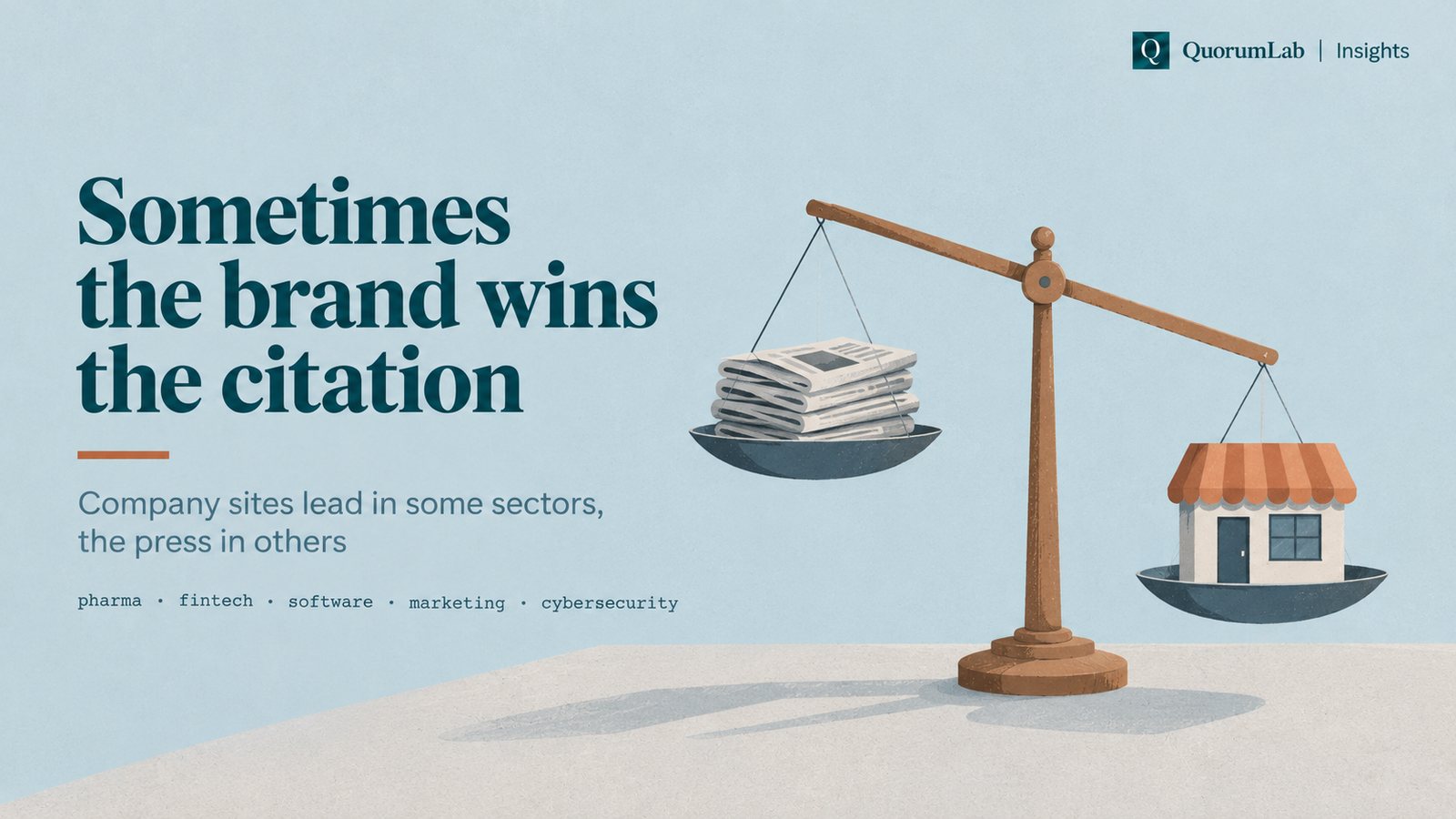
In some sectors AI cites the websites of companies themselves more often than independent sources. Profound (30 July 2026, 11.84 billion citations, 29 industries, 8 models, 16 April to 16 July 2026) found that about 57% of citations lead to company websites: 47% for ChatGPT and 69% for Gemini. In 24 of 29 industries, the typical Profound customer gets more citations from company websites than from any other group. Here a company website means the website of any company, not only the one the user asks about, so competitors are included.
| Sector | Figure for the typical Profound customer |
|---|---|
| Pharma and biotech | 59% of citations from independent sources; 33% to company websites |
| Fintech | 15% of citations from independent sources |
| Software and SaaS (cloud services sold by subscription) | 11.4% of citations from independent sources |
| Marketing | 72% of citations to company websites |
| Cybersecurity | 74% of citations to company websites |
| Government and nonprofit | 15.9% of citations to company websites |
That is why Muck Rack’s finding that about 84% of citations go to independent sources cannot be carried over to every sector. Its independent sources include not only journalism but also Wikipedia, social networks, academic and government sites and other companies’ blogs. Journalism itself accounts for about 27%, and paid placements for 0.3%.
Why do the studies disagree?
The studies disagree because the source layer is measured with different rulers: each study has its own category definitions, set of models, prompts and period. Muck Rack asked about consumer topics, while Profound looked at the categories of its own customers. Even a single ruler gives different readings in different months. According to Meltwater (report for August 2026, about 7.3 million citations, 8 platforms, prompts without brand names), the share of the Earned/News category among cited domains fell from 37.6% in May to 29.4% in August. Before quoting anyone’s percentage, you need to find out what exactly was counted in it.
Platforms say openly that source selection is part of the design: Perplexity’s co-founder and chief executive Aravind Srinivas said in an interview at Stanford GSB (June 2025) that the idea behind Perplexity is that every sentence of an answer should rest on a site with a certain level of authority and trust. This describes the principle, not a measurement of how it works.
What is missing from the open data?
We found no complete ranking of publications for all sectors and all major models in open sources. Muck Rack names outlets for 17 industries, but for three models and only in the text of its report. For cybersecurity, recruitment, marketing and legal services we found no open data naming publications. All the citation studies this article relies on (Muck Rack, Profound, Meltwater, Growfusely, Datadab) were published by companies that sell tools for tracking what AI says about a company, or PR and marketing services.
What does QuorumLab do?
QuorumLab currently studies which sources AI cites most often, and works with the information environment from which AI takes its answers. That work starts with a measurement for your sector and for the models your buyers use, and is checked by measurement too. How QuorumLab works describes the method in five steps: measure, map the likely causes, make an evidence-based change, measure again and adjust the course. QuorumLab does not control external AI systems, so it does not promise a particular AI answer.
Frequently asked questions
How much does Wikipedia matter for AI citations?
It depends on the model. According to Muck Rack (May 2026, more than 25 million links, consumer-style prompts), Wikipedia is among the three most-cited domains in 12 of 17 industries for ChatGPT, in 8 of 17 for Claude and in 3 of 17 for Gemini. In the same study Wikipedia is ChatGPT’s most-cited domain overall.
Does AI cite Reddit and YouTube?
Gemini does; the other models do so much less. In Muck Rack’s May 2026 study, Reddit was Gemini’s single most-cited domain, while ChatGPT cited Reddit 16 times and Claude did not cite it at all. YouTube accounted for about 2.1% of Gemini’s citations and about 2.0% of ChatGPT’s, while Claude returned no YouTube citations.
Does “independent source” mean journalism?
No. In Muck Rack’s May 2026 study, about 84% of citations go to independent sources, meaning those a company neither controls nor pays to appear in, while journalism accounts for about 27%. The rest of the independent group is Wikipedia, social networks, academic and government sites and other companies’ blogs.
Does AI cite recent articles or old ones?
Mostly recent ones. According to Muck Rack (May 2026), 57% of journalism citations with a known publication date were published within the previous 12 months. Citations peak in the first month after publication and fall quickly up to the sixth month, but articles more than three years old still account for a meaningful share.
How can a company find out which publications its AI answer rests on?
Only by measuring, for its own sector and for the models its buyers use. The studies above describe their own samples and categories, so each percentage has to be read together with what was counted in it. For example, Muck Rack covers consumer prompts, while Profound covers the categories of its own customers.
Conclusion
In different sectors the source layer is made of different publications and platforms. In Muck Rack’s consumer-style queries, review and reference websites lead in finance, travel, healthcare and technology, and Axios and AP News lead in news-driven sectors. In some sectors company websites are cited more often than the media, and each model has its own set. To find out which publications your company’s AI answer rests on, measure it for your sector and for the models your buyers use; How QuorumLab works sets out that approach.
Sources
- Product.ai, Trust in AI Commerce Report, 14 October 2026: https://product.ai/research/trust-in-ai-commerce-report/
- L.E.K. Consulting, “Thanks to AI, Consumers Are Arriving at Brand and Retailer Sites Ready to Buy”, 13 July 2026: https://www.lek.com/insights/consumer-products/thanks-ai-consumers-are-arriving-brand-and-retailer-sites-ready-buy
- BrightLocal, Local Consumer Review Survey 2026, 10 March 2026: https://www.brightlocal.com/research/lcrs-ai-trust/
- eMarketer on a rater8 survey, “AI is shaping consumer decisions to switch doctors”, 5 June 2026: https://www.emarketer.com/content/ai-shaping-consumer-decisions-switch-doctors
- G2, AI search insight report (March 2026): https://learn.g2.com/g2-2026-ai-search-insight-report; summary of the research, 15 April 2026: https://company.g2.com/news/g2-research-the-answer-economy
- Digital Commerce 360 on Forrester data, 22 January 2026: https://digitalcommerce360.com/2026/01/22/forrester-b2b-buying-ai-2026/
- Muck Rack, What Is AI Reading?, May 2026: https://media.muckrack.com/documents/What_Is_AI_Reading__May_2026.pdf; press release: https://aimagazine.com/globenewswire/3290268
- Profound, “Where do AI citations come from”, 30 July 2026: https://tryprofound.com/blog/where-do-ai-citations-come-from
- Meltwater, AI Search Visibility Report: August 2026 (published 11 September 2026): https://www.meltwater.com/en/blog/ai-search-visibility-report-august-2026
- Growfusely, AI citation analysis for B2B software, 28 July 2026: https://growfusely.com/blog/ai-citation-analysis-b2b-software/
- Datadab, What ChatGPT actually cites, 24 May 2026: https://www.datadab.com/blog/what-chatgpt-actually-cites/
- Stanford GSB, interview with Aravind Srinivas (View From The Top), 18 June 2025: https://gsb.stanford.edu/insights/perplexitys-aravind-srinivas-infinite-value-knowledge
How this article was prepared: written by Artem Rybalka. AI tools assisted with research, drafting and translation; the author reviewed the text and checked all facts and sources.