Insights
Cleared in court, guilty in AI answers: how a virtual criminal record works
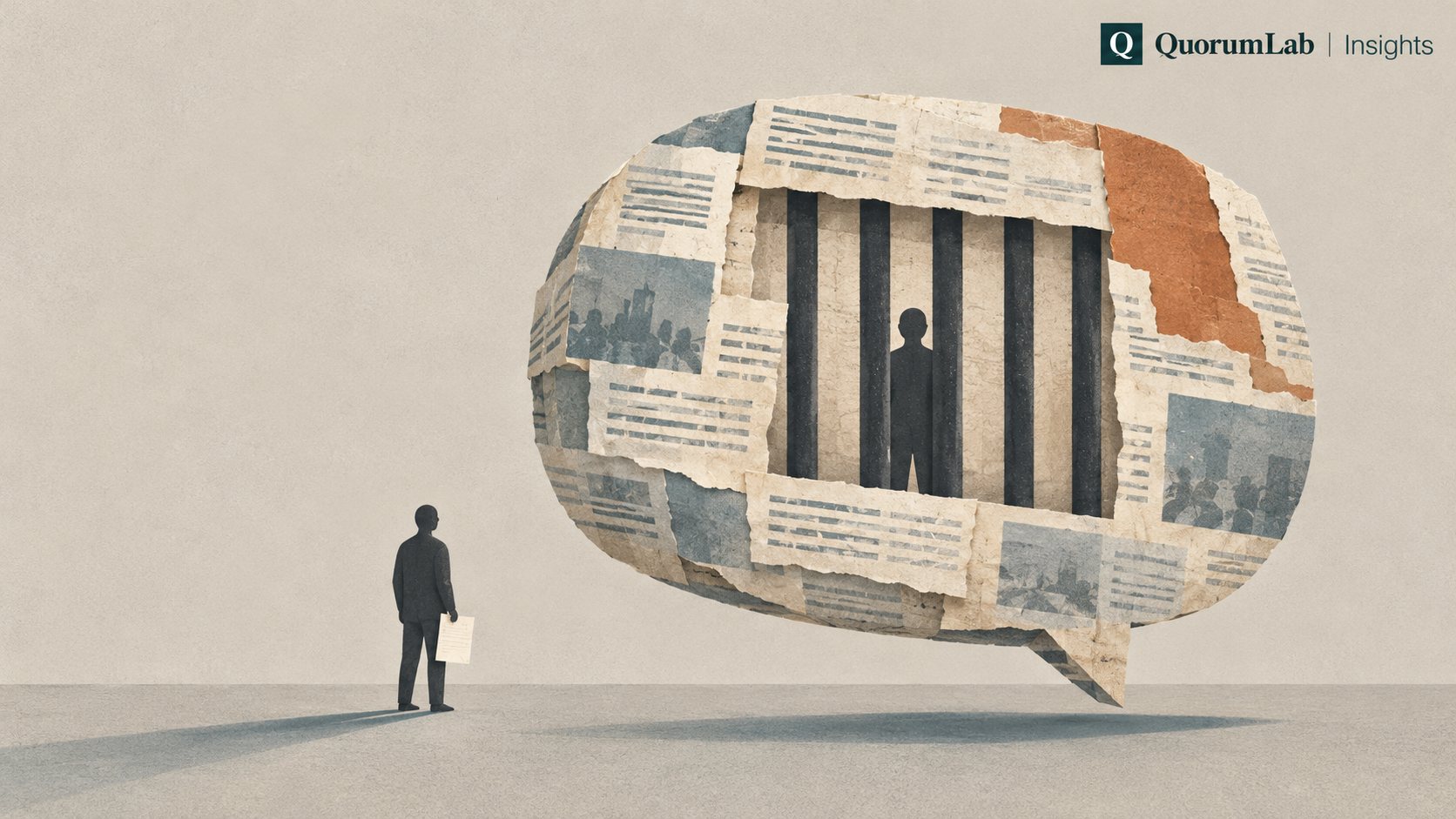
The court closes the case. You walk out of the courtroom a free person and assume the story is over. In an AI answer, it is only beginning. For a public figure, as I see it, the price of this gap is a deal, an appointment or an invitation that falls through, and you never find out why.
What is a virtual criminal record?
A virtual criminal record is an old accusation or conviction that the justice system has closed, but that anyone can still find under the person’s name. The phrase comes from Belgian court rulings in a case that later reached the European Court of Human Rights. In November 1994 the Belgian daily Le Soir ran a piece on a series of fatal road accidents. It named a driver who was later convicted. As far as the justice system was concerned, his story ended in 2006, when the Court of Appeal granted him rehabilitation. Two years later the paper put its archive online, free and searchable, going back to 1989. Anyone who typed his first name and surname into Google, or into the paper’s own search box, found the 1994 article straight away.
In 2010 he asked Le Soir to take the article down, or at least remove his name. The paper refused, saying it had asked Google to drop the link. So he went to court, and the Belgian courts, up to the Court of Cassation in 2016, ordered the paper to anonymise the text. The publisher of Le Soir took the case to the European Court of Human Rights. In July 2023 the Grand Chamber ruled, by twelve votes to five, that anonymisation was a proportionate measure. Along the way, the Belgian courts had found that unrestricted online access to the old article could create a “virtual criminal record” for him.
Rehabilitation in 2006, the request in 2010, Strasbourg’s final word in 2023. For the justice system the case had long been closed, yet the dispute over whether his name could still be found in that old article went on for another thirteen years.
The Le Soir story is about rehabilitation after a conviction, not an acquittal. The mechanism is the same for an acquittal and for any closed case: the decision has been made, and the record keeps living.
Remember Hester Prynne in The Scarlet Letter? Her punishment is long over, yet the town keeps reading the letter on her dress. The mark outlives the event. Today that mark is more and more often carried by a machine’s answer.
Why doesn’t a closed case fade with time?
A closed case doesn’t fade in AI answers because time is not what removes it; sources are. The common belief is that the truth will surface on its own: the case is closed, the court has cleared you, sooner or later everyone will know. There is a second familiar hope too. If something goes wrong, you can “bury” the old article under new publications, or go to court. That is too simple.
A closed case lives on in AI answers for a reason. The causes sit in the information environment, and they can be found and removed through lawful means.
The question of who is to blame (the AI, the newspaper that never updated its old story, or the person themselves) gets us nowhere, in my view. That isn’t the point. The point is that we know how to close this gap.
Why does this matter more now?
I am convinced that AI shapes people’s reputations more and more, and with them, their lives. According to the Reuters Institute’s Digital News Report 2026, 10% of adults across the countries surveyed now get news from AI chatbots every week, up from 7% a year earlier. And in a survey across 27 countries, just 4% of respondents say they always or often click through from an AI answer to the original source (19% from search; in the UK, 1% from AI).
Picture it. A partner, a journalist or a board member asks an AI about you. They get a fluent answer and will almost certainly not open a single link. The court ruling sitting somewhere in a database never reaches them.
Back in 2024 the European Data Protection Board warned that ChatGPT’s outputs are probabilistic and can be biased or made up, and that users are likely to take them as factually accurate, including when they concern individuals. The data accuracy principle still applies in full.
I see that many people have no idea how AI puts an answer together. So they don’t know what to correct or where, and in effect they damage their own lives, incomes and deals. Most of the time, I’m sure, you never even learn what the other side read about you. I wrote about that blind spot in AI: the invisible participant in negotiations.
Why can’t the EU rule for search engines fix an AI answer?
The EU rule for search engines assumes a list of results, and an AI answer has no list. In 2019 the Court of Justice of the EU (case C-136/17) ruled that where information relates to an earlier stage of criminal proceedings and no longer matches the current situation, a search engine must either remove the links or arrange its results so that the overall picture reflects the current legal position. Links to up-to-date information must come first.
That rule works as long as there is a list. An AI answer has no list. There is one fluent summary, and it has no “first place” where an acquittal could go.
So how does an AI decide what to summarise? Two studies give an uncomfortable answer.
What does research show about outdated information in AI answers?
Research on AI systems shows that outdated information can override correct information, and that a date on its own does little to stop it. The team behind the HoH benchmark, presented at ACL 2025 (96,124 questions built from Wikipedia snapshots), tested what happens when outdated information sits next to current information. The share of fully correct answers fell by 10 to 24 percentage points, depending on the model. With the retrieval models they tested, outdated passages made it into the top five results more than half the time. The authors’ conclusion: outdated information is more dangerous than having no relevant information at all.
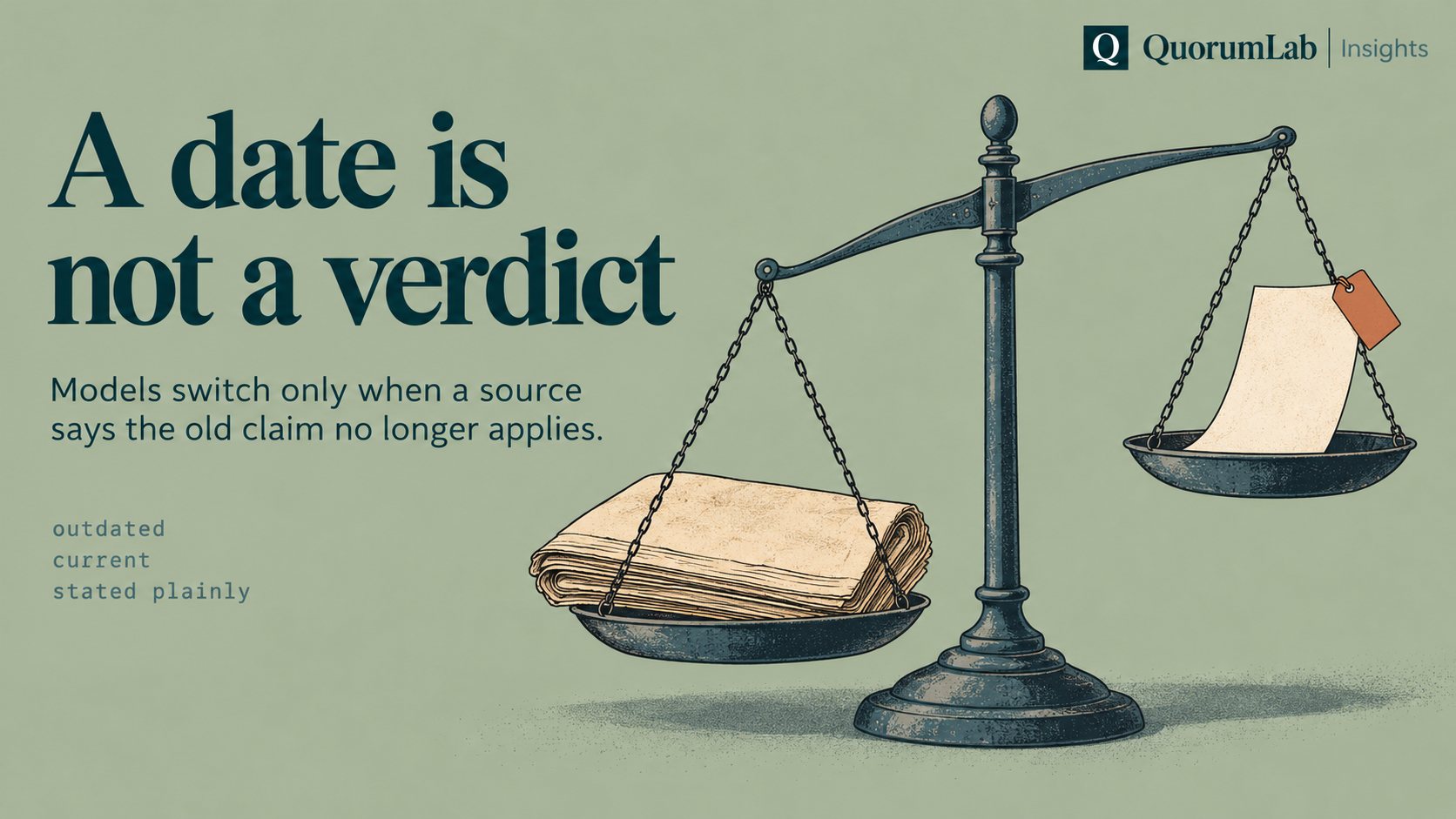
A group at the University of Southern Denmark went further in a preprint published in September 2026. They collected 317 cases where a correct answer had been replaced by a new one (in medicine, law, software and platform policy) and tested 12 models. For the open models, a single outdated document flipped a correct answer in 17 to 91% of cases. Dates on their own had only a modest effect. The larger models switched to the current answer almost every time when they were told explicitly from what point the earlier claim no longer applied.
| Study | What was tested | Main finding | Limits |
|---|---|---|---|
| HoH benchmark, ACL 2025 | 96,124 questions built from Wikipedia snapshots; current and outdated information side by side | Fully correct answers fell by 10 to 24 percentage points; outdated passages reached the top five results more than half the time with the retrieval models tested | Questions about general topics, not about people or court cases |
| University of Southern Denmark, preprint, September 2026 | 317 cases where a correct answer was replaced (medicine, law, software, platform policy); 12 models | One outdated document flipped a correct answer in 17 to 91% of cases for open models; dates alone had a modest effect; larger models switched when told explicitly that the earlier claim no longer applied | Not yet peer reviewed; not about people |
| Reuters Institute, Digital News Report 2026 | Survey of news use; click-through asked in 27 countries | 10% use AI chatbots for news weekly (7% a year earlier); 4% always or often click through from AI to the source (19% from search; UK 1%) | News use, self-reported |
The research shows a model can be led astray by an outdated document even when it knows the right answer, and that the reader of an AI answer rarely checks the source.
My conclusion from this work: AI barely weighs dates. It weighs what it has been given to read.
That is how I understand the mechanism. The old article about the accusation hasn’t gone anywhere. The court ruling, in my view, almost always sits somewhere else and speaks a different language. If no source the AI can find says plainly “the charges were dropped”, then by my reading the case is still open as far as the summary goes.
Why don’t waiting, burying or going to court fix the AI answer?
Waiting, burying and going to court leave open the question of which sources an AI actually reads. Waiting, in my view, is pointless: in this mechanism, time changes nothing.
“Burying” the negative coverage under new publications misses too. As I see it, an AI doesn’t scroll to the end of the results; it builds its answer from what it considers reliable. An industry analysis by BuzzStream (4 million AI citations over one week, mostly large brands) found that press releases syndicated through Yahoo and MSN made up 0.04% of all citations. That is a correlation, and causation hasn’t been shown, but the inference is hard to avoid: a message the AI doesn’t read fixes nothing.
The courts do work, and the Le Soir story proves it. But a court corrects one specific source. It doesn’t tell you which sources feed the AI’s answer, or how many there are. So going to court is one possible route. It shouldn’t be the first step.
Even the platforms can’t always help directly. In 2025 the digital rights organisation noyb filed a complaint with the Norwegian data protection authority after ChatGPT invented a story that a Norwegian man had murdered his children. According to noyb, OpenAI had said back in 2024, in response to an earlier noyb complaint, that it could not correct the data and could only block it for certain prompts. noyb reports that the false claim about the Norwegian man stopped appearing after ChatGPT began searching the internet when asked about people. “The GDPR is clear. Personal data has to be accurate,” said noyb data protection lawyer Joakim Söderberg at the time.
This story can’t prove cause and effect, but the lesson I take from it is this: the answer depends on the sources the AI reads. That is the key.
| Usual remedy | What it changes | Limit described in this article |
|---|---|---|
| Waiting | Nothing in the sources | In my view, time changes nothing in this mechanism |
| Burying the old story under new publications | Adds material, not necessarily material the AI reads | Syndicated press releases made up 0.04% of AI citations in BuzzStream’s one-week analysis (a correlation) |
| Going to court | Corrects one specific source, as in the Le Soir case | Doesn’t show which sources feed the AI answer, or how many there are |
| Asking the platform | Depends on the platform | According to noyb, OpenAI said in 2024 it could not correct data, only block it for certain prompts |
What should you do when AI still repeats a closed case?
When AI still repeats a closed case, start by finding the cause, then fix it, then check the result. I disagree with all the usual advice for one reason: it starts with action. The right order is the reverse.
First, measure what the AI says about the person today and which sources it relies on. Then find where in the information environment the old version is stuck, and why the court’s decision never reached it. Next, add documented, verifiable material on the current position through lawful means. And measure again to see whether the AI reflects it.
| Step | What happens |
|---|---|
| Measure | Record what AI says about the person today and which sources it relies on |
| Map the cause | Find where the old version is stuck and why the court’s decision never reached it |
| Act | Add documented, verifiable material on the current position through lawful means |
| Measure again | Check whether the AI now reflects the current position |
At QuorumLab we call this the Navigational Method: measure, map the cause, act, measure again. We have the methods and tools this work requires. At QuorumLab we distinguish established fact, allegation, interpretation and hypothesis; we work on the information environment so that the current status of a case becomes available to AI; and we measure whether AI has started to reflect it. We don’t promise to control anyone else’s AI, and we don’t remove legitimate criticism. Our Reputational Forensics page describes how this work is organised.
Where does the evidence stop?
The evidence in this article comes from studies of general questions, not of answers about people. The studies I rely on tested questions about sport, finance, medicine and law, and the Danish paper has not yet been peer reviewed. Applying them to reputation is an argument by analogy. The mechanism is the same, though: a model retells whatever it has been given, and confuses “was” with “is” when the source doesn’t say plainly what has changed.
Cleared in court, guilty in the retelling
An AI remembers nothing in the human sense. It bears no grudges and passes no sentences. It retells the world it has been shown, and in that world the accusation is louder than the acquittal.
The case is closed in court. It stays open in the AI’s answer until the current position appears in the sources the AI uses. Waiting is pointless; acting blind is risky. The first step is to measure what AI says about you today and which sources it draws on.
A court overturns the verdict. A source overturns the retelling.
Frequently asked questions
Does the EU’s 2019 ruling on search engines apply to AI answers?
The 2019 judgment of the Court of Justice of the EU in case C-136/17 concerned search engines. Where a request is justified, it requires a search engine to remove links about an earlier stage of criminal proceedings; otherwise, it must arrange its results so that up-to-date information comes first. An AI answer has no list of results, so there is no first place where the current legal position could go.
Can a court order make AI stop repeating an old accusation?
A court order corrects the specific source it covers. In the Le Soir case, the Belgian courts ordered the newspaper to anonymise its online article, and the European Court of Human Rights found that proportionate. A court order does not show which sources feed an AI answer, or how many there are. Going to court is one possible route, but it shouldn’t be the first step.
Will a press release about the closed case fix the AI answer?
A press release fixes nothing if the AI doesn’t read it. In BuzzStream’s one-week analysis of 4 million AI citations, mostly for large brands, press releases syndicated through Yahoo and MSN made up 0.04% of all citations. That is a correlation, not proof of cause. What matters is whether the sources the AI actually uses state the current position plainly.
Is it enough to put a date on the new information?
A date alone is unlikely to be enough. In the University of Southern Denmark preprint, dates on their own had only a modest effect on which answer a model gave. The larger models switched to the current answer almost every time when they were told explicitly from what point the earlier claim no longer applied. The study is not yet peer reviewed and did not test answers about people.
Can QuorumLab guarantee what AI will say about me?
No. QuorumLab does not promise to control anyone else’s AI and does not remove legitimate criticism. QuorumLab measures what AI says and which sources it uses, works on the information environment through lawful means so that the current status of a case becomes available to AI, and measures again to see whether AI has started to reflect it.
Sources
- Court of Justice of the European Union: Judgment in Case C-136/17 GC and Others v CNIL, press release (24 September 2019)
- European Court of Human Rights, Grand Chamber: Hurbain v. Belgium, application no. 57292/16 (4 July 2023); case summary: Columbia Global Freedom of Expression
- European Data Protection Board: Report of the work undertaken by the ChatGPT Taskforce, paras 30 and 31 (23 May 2024)
- Reuters Institute, A. Ross Arguedas: Emerging uses of AI chatbots for news, Digital News Report 2026 (16 June 2026)
- Ouyang, J. et al.: HoH: A Dynamic Benchmark for Evaluating the Impact of Outdated Information on Retrieval-Augmented Generation, Proceedings of ACL 2025, pp. 6036-6063 (July 2025)
- Ahmed, M. S., Galke Poech, L. and Röttger, R.: Stale-Document Poisoning: When Outdated Retrieval Overrides Correct Model Answers, arXiv preprint (25 September 2026)
- noyb: AI hallucinations: ChatGPT created a fake child murderer (20 March 2025)
- Search Engine Journal: AI Search Barely Cites Syndicated News Or Press Releases, on research by BuzzStream and Citation Labs (16 March 2026)
- QuorumLab: Reputational Forensics; How we work