Insights
Should you run ads in ChatGPT? Five questions to settle first
Should we run ads in ChatGPT? Someone has probably put that question to you already. More than 100,000 advertisers have run campaigns there in the eight months since launch, ads now run in 89 countries, and your budget is next in line.
Before you answer, it is worth being clear about what you are buying. Here are five questions to settle before you pay rather than after the first report lands. Each has an answer in the documentation or in the measurements, and each changes what you should expect from a campaign.
What does the ad buy?
The ad buys a placement, not a mention. It appears below ChatGPT's answer, labelled as an ad and separate from the answer itself. Since October OpenAI has been testing a second format: an ad shown while an image is being generated, also labelled and also separate from the image. What decides which ad runs is the topic of the conversation in front of the user, your landing page, the hints you supply and what you bid. What comes back to you is impressions and clicks, in aggregate.
What a ChatGPT ad includes, according to OpenAI's documentation (November 2026)
| Parameter | What the documentation says |
|---|---|
| Placement | Below ChatGPT's answer, labelled as an ad; a second format is being tested during image generation |
| Selection | Topic of the current conversation, landing page, advertiser's hints, bids |
| Who sees it | Users on the Free and Go plans |
| Who does not | Plus, Pro, Business, Enterprise and Edu; accounts identified as under 18; Temporary Chat |
| What you receive | Aggregated impressions and clicks |
| What is not included | Influence over the answer. Advertisers "have no ability to shape, rank, or alter ChatGPT's responses" |
What is not in the purchase, OpenAI states plainly: advertisers "have no ability to shape, rank, or alter ChatGPT's responses". That is the company's own statement, and we take it as its official position.
The expectation people most often bring to us sounds different: if we pay, ChatGPT will start recommending us, and organic traffic will rise along with it. That is not on offer. It is worth saying so inside the team before launch, so that nobody later goes looking in the report for something that was never going to be there.
Who will see the ad?
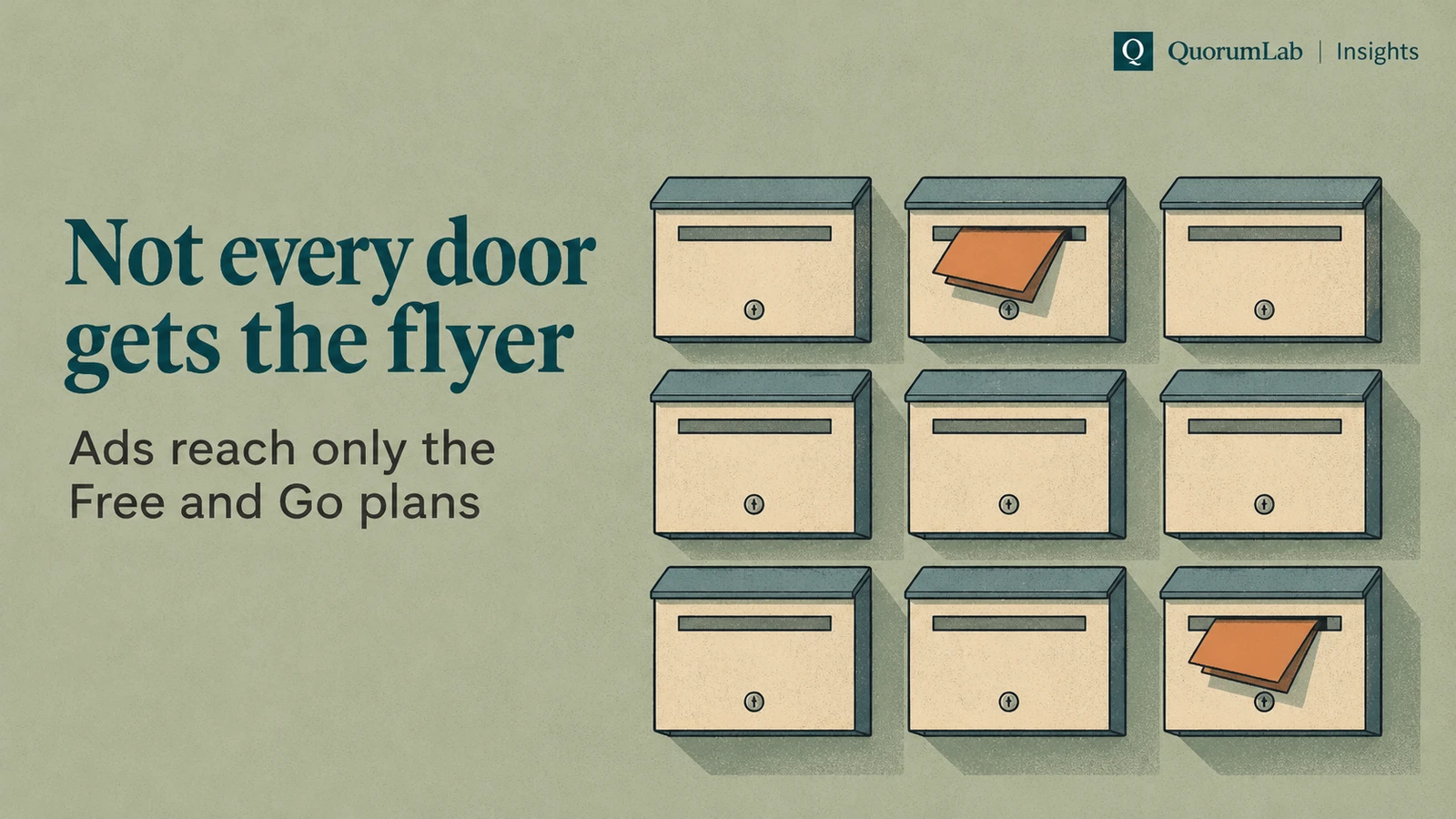
Ads reach a narrower audience than the size of ChatGPT suggests. They are shown to users on the Free and Go plans. Plus, Pro, Business, Enterprise and Edu have none. Neither do accounts identified as belonging to people under 18. Temporary Chat shows no ads.
One more detail rarely makes it into planning: the free plan also comes in a version with no ads at all, with fewer messages a day and without some tools. Part of your potential audience may have chosen it.
For European companies there is another: personalised ads are not initially available in the European Economic Area or Switzerland. Selection runs on the context of the current conversation rather than on a user's history.
Which leads to a question where we have a view rather than data. The buyers that matter in a long sales cycle spend weeks comparing suppliers and reading up on them. Our view is that people doing that work are more often on a paid plan, and paid plans carry no ads. The counter-argument is obvious enough: OpenAI's post on the European launch lists choosing business software among the things people come to ChatGPT for, and nothing stops a free account from asking exactly that.
The open data does not break plans down by type of user. So before launch it is worth answering honestly: is your buyer really on the free plan?
How will you separate paid visits?
You separate them with tags set before the first impression, not with analysis afterwards.
Static UTM tags are allowed in the links you submit, they survive the click, and ordinary analytics reads them. OpenAI also has a click reference of its own, oppref, for paid attribution. Skip the tags and the visits arrive as referral or Direct, mixed in with everything else and no longer separable.
Then the discrepancies start. Conversions in Ads Manager reports can be modelled, and the figures there may not match your analytics: attribution windows, time zones, cookie consent, deduplication. Seer Interactive writes that paid and organic visits from ChatGPT still cannot be cleanly separated in GA4.
One more line in the report deserves suspicion. The crawlers that review ads may open the landing pages you submit with tracking parameters on them, and some third-party analytics logs those visits as paid traffic. Nobody bills you for them, and they still show up in your numbers.
Tag your links before the first impression, and decide in advance which system you trust.
What will the report not show?
It will not show whether the ads changed what ChatGPT says about your company. A tag answers the question of where a click came from, and stops there.
Here the first large outside measurement helps. In July 2026 SE Ranking ran 50,006 commercial prompts across twenty niches in the United States. Ads appeared on 25.94% of prompts, always as a single card below the answer. The telling figure is a different one: in 96.37% of placements the advertiser was not among the answer's cited sources.
How often the advertiser appeared in the answer beside its own ad (SE Ranking, 50,006 US commercial prompts, data collected 23 July 2026)
| What was measured | Share of placements |
|---|---|
| Prompts that returned an ad | 25.94% |
| Advertiser not cited among the answer's sources | 96.37% |
| Advertiser's domain among the cited sources | 3.63% |
| Exact advertised URL among the cited sources | 0.09% (12 cases) |
| Brand mentioned in the answer text | 4.44% |
| Ads no more related to their query than to a random one | 14.35% |
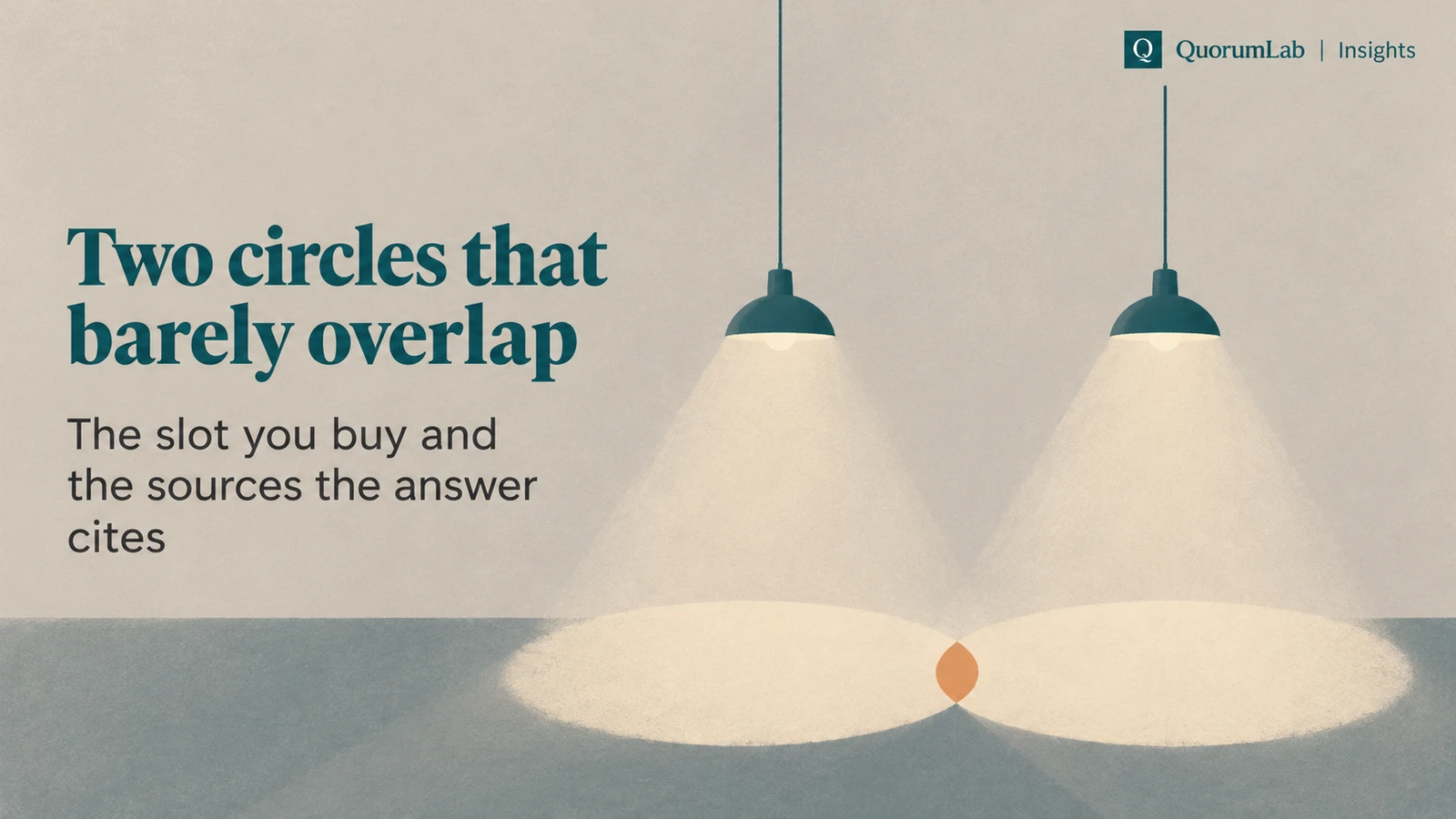
The figure measures how often an advertiser turns up among the sources of the answer its own ad sits beside. It does not measure causation and does not prove that ads have no effect on answers. It shows that the slot you buy and the companies named in the answer barely overlap. This is one day's snapshot, the United States only, Free and Go only, and it was made by a company that sells an ad-tracking tool.
The independent audit published at the AIES 2026 conference did not test that either. Running 91 test accounts in the United States, its authors logged 63,657 interactions in the main March window and found an ad in 5.61% of them, always set apart from the answer text.
On the expectation that organic traffic will rise, there is one more study. Economists at the Vienna University of Economics and Business and the Frankfurt School of Finance and Management compared countries where ads had launched with EU countries where they had not yet: 1,898 online shops, almost ten billion visits, June 2025 to August 2026. After ads launched, ChatGPT sent those shops roughly 6 to 8% fewer visitors through unpaid recommendations. The authors themselves call this a range across assumptions rather than a precise interval, the central estimate is not statistically significant, and the paper has not been peer reviewed. It will not serve as proof. It does not support the expectation that ads lift organic traffic either.
It is also worth keeping in mind that an ad and an answer in the same conversation may say different things. We have no direct examples. There is an indirect sign in the same SE Ranking data: 14.35% of ads were no more closely related to their own query than an ad paired with a random query. That is a mismatch with the topic of the query, not a contradiction of the text of the answer. So our advice is simply to look at your own ads next to the answers on the topics that matter to you.
What is the answer itself built from?
It is built from what AI reads around the company, and almost none of that is paid. Which sources those are differs by sector, as we set out in a separate study of the media and review sites AI cites most.
According to a Muck Rack measurement (May 2026, more than 25 million links in answers from ChatGPT, Claude and Gemini), about 99% of cited links are not paid: paid and advertorial content accounts for 0.3%, and about 84% for earned media. Earned media in that report is a broad category, and critics argue it is defined too widely. The measurement was made by a company that sells tools in this field, and it shows correlation.
Where you can act is clearer from the academic paper on generative engine optimisation, "GEO: Generative Engine Optimization" (KDD 2024): changes to the content of the pages themselves, such as adding quotations and statistics, raised the visibility of a source in a generative system's answer by up to 40% on one of the metrics. The experiment ran on two systems in a simplified setting. The lever, in other words, sits in the material itself rather than in a bidding screen.
Sometimes companies try a shortcut instead. Three companies told us that between them, from more than a thousand accounts, they had tried to get AI to recommend them. By their account the answer adapted in the account the conversations were run from; from other accounts and other regions there was no effect. We did not measure this, and we do not recommend the approach.
How does QuorumLab approach this?
We treat an AI answer as a symptom. The cause sits in the material around a company that AI can read: its own site, reference and specialist resources, publications, discussions in the places buyers go. That is why our first step is measurement rather than content. We record what AI actually says across several questions and several runs, trace where that picture comes from, change what can be changed and measure again. How we work sets out the method in full. No one can say in advance which change will register, and external AI systems are not ours to control, so a particular answer is not something we can promise.
What should you do with the answers?
If after these five questions you decide to go ahead: tag your links before the first impression, reconcile Ads Manager with your analytics, and expect from the ads what they sell, which is a placement beside an answer.
If you decide not to, or to wait: measure what AI says about your company now, and look at which sources it draws on. That work will be needed either way.
Either way, treat the ad account and the answer as two separate problems. The first one you can buy your way into. The second one you have to earn.
Frequently asked questions
Which ChatGPT plans show ads?
Only Free and Go. There are no ads on Plus, Pro, Business, Enterprise or Edu, none in Temporary Chat, and none for accounts identified as belonging to people under 18. A no-ads version of the free plan also exists, at the price of fewer messages a day and the loss of some tools.
Are ChatGPT ads personalised in Europe?
Not initially. In the European Economic Area and Switzerland, personalised ads are not available at the start. Ad selection runs on the context of the current conversation rather than on a user's wider history. Ads are labelled and shown separately from the answer.
Can paying for ads get my brand into ChatGPT's answer?
OpenAI states that advertisers have no ability to shape, rank or alter its responses. The largest outside measurement so far points the same way: in 96.37% of placements the advertiser was not among the answer's cited sources. That measures overlap rather than causation, but nothing in it suggests the slot buys a mention.
How do I tell paid visits from ChatGPT apart from the rest?
Tag your links with static UTM tags before the first impression; OpenAI's documentation allows them and they survive the click. OpenAI also has its own click reference, oppref, for paid attribution. Without tags, visits land in referral or Direct. Expect Ads Manager and your own analytics to disagree.
Why might my report show ChatGPT traffic I cannot explain?
Some of it may not be people. Crawlers that review ads open the landing pages submitted with tracking parameters, and certain third-party analytics counts those visits as paid traffic, even though nobody is billed for them. Modelled conversions in Ads Manager are a second reason your two systems will disagree.
If ads do not shape the answer, what does?
What AI reads around the company. In one measurement of more than 25 million cited links, about 99% were not paid and about 84% came from earned media. Research on generative engine optimisation points to the content of the sources themselves as the place where changes register.
A note on the earlier version
An earlier and shorter version of this argument, written in a personal capacity, appeared on Medium on 30 October 2026: Does paying for ChatGPT ads change what ChatGPT says about your company?. This article updates it with measurements published since, including the SE Ranking study and the Vienna and Frankfurt School paper.
Sources
- OpenAI Help Center, "Ads in ChatGPT" (page as of 28 October 2026).
- OpenAI Help Center, "Ads in ChatGPT: The Basics".
- OpenAI Help Center, "Conversion Measurement".
- OpenAI, "Our approach to advertising and expanding access to ChatGPT", 16 January 2026.
- OpenAI, "Building advertising for the way people use AI", 5 October 2026.
- OpenAI, "ChatGPT Ads expands to 26 new countries", 21 October 2026.
- SE Ranking, "ChatGPT Shows Ads for 1 in 4 Commercial Prompts", 10 August 2026, data collected 23 July 2026.
- Lurie, Encarnación, Friedler and Metaxa, "The Beginning of ChatGPT Ads", Proceedings of AIES-26, vol. 9, no. 3, pp. 1753 to 1764.
- Frankfurt School of Finance and Management, press release on Kaiser and Schulze, "Can Advertising Fund Free AI?", 3 November 2026.
- Muck Rack (Generative Pulse), "What Is AI Reading", press release of 7 May 2026.
- David Clare, "The 84% myth", PR Daily, 17 August 2026.
- Aggarwal et al., "GEO: Generative Engine Optimization", KDD 2024.
- Seer Interactive, "Your AI Traffic Is Hiding", updated 22 June 2026.
How this article was prepared: written by Ievgen Sapsai. AI tools assisted with research, drafting and translation; the author reviewed the text and checked all facts and sources.