Insights
Can a Community of Practice Support Learning and Income-Generating Projects?

A personal essay.
A community may have thousands of members and still depend on one organiser to keep it alive. I have been looking for a model in which people do not simply wait for new content, but learn from one another and build something useful together. Etienne and Beverly Wenger-Trayner’s communities-of-practice framework gives me a way to think about that possibility. Whether it can also support income-generating projects is a question I want to investigate, not a result I can claim to have established.
What kind of community am I trying to understand?
I am trying to understand a particular form of “business community”: a community in which people learn from one another and may also develop income-generating projects. This essay is a working document within a broader study of the different forms and types of online communities, their formation, establishment, and development.
In this work, I have attempted to draw on my own practical experience and the Wenger-Trayners’ academic research.
This essay focuses on the question of a particular form of “business community,” although I am not yet ready to say that this term is entirely appropriate. For now, it is only a working definition that may become more precise through the actual practice of implementation, or even after conducting field research, launching a “community of practitioners in business,” and observing its development over some time.
For the past five years, I have been involved in the practice of creating and developing communities on Twitter (those communities are no longer active), and now I am working on Reddit. I have created communities in such areas as photography, applied science, and startups. I have participated in the development of a financial community, and I am now working on reviving and developing an old media studies community on Reddit.
What happens when everyone waits for the organiser?
When everyone waits for the organiser, a community depends on a constant supply of content, and members drift away when it stops. At first, like many people who face the task or need to create a community, I encountered the question: “How do I organise all of this?” There is nothing surprising about this. Many people, including myself, came to communities after working on platforms such as Facebook, YouTube, Instagram, and TikTok.
To put it simply, they all have one thing in common: imagine a model where there is an organiser standing on a pedestal, and people are standing around waiting to see what will happen. They are waiting for content, instructions, announcements, and it reminds me of the old Roman expression: “Bread and circuses!” Sometimes, they even demand it. If there is neither bread nor circuses, this group migrates to wherever they can find them.
And this is where we come to something I did not understand at first. A community does not belong to its creator. Yes, it may seem otherwise, because after all, it was the creator who found the place, organised its launch, and probably spent more time and resources on it than anyone else.
But this becomes easy to understand if we ask a question: What is the most important thing in a community? What is the fundamental element that cannot be excluded under any circumstances or conditions?
That element is the person, the people who are part of the community and participate in its life. Without people, a community does not exist.
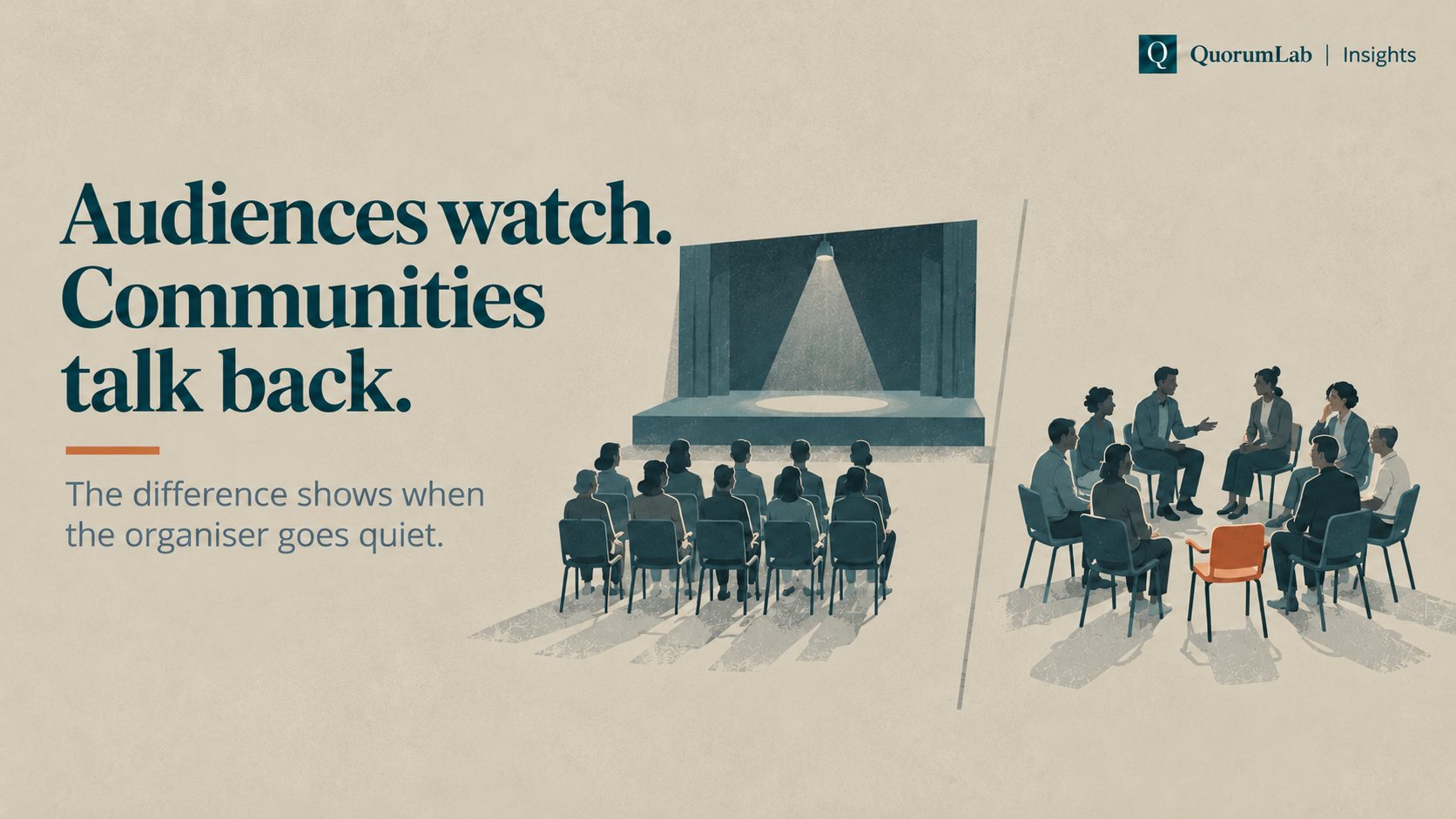
All right, you might say, people are the foundation of a community. But what happens between these people? After all, people can simply stand around the organiser and wait for the next announcement. There may be a thousand of them, or ten thousand. They are present, but what happens if the organiser stops creating content?
And this made me want to understand what kind of model would not need to be constantly fed, and to try to create one that would not stop functioning in the organiser’s absence.
Why did the Wenger-Trayner model interest me?
The Wenger-Trayner model interested me because it is simple and because it describes what I had already been doing in my own communities. Recently, I became acquainted with the Wenger-Trayners’ work through their short paper Communities of Practice: A Brief Introduction (Etienne and Beverly Wenger-Trayner, 2015). So far I have read only this brief introduction, not the authors’ longer works, but I have already seen significant similarities with what I was doing in my own communities.
Currently, my area of interest is the creation and development of a community of an applied nature, where people could learn and achieve results that could provide them with financial benefits. And in my view, the Wenger-Trayners’ model of communities of practice could serve as the structural framework for this model.
The first reason I consider this model optimal for this task is its simplicity: it consists of just three elements.
To be honest, initially I tried to build something on top of the model or add elements or mechanisms that would act as regulators within a business community. But after several hours of such attempts and constantly making the system more complicated, I gave up trying to find an immediate solution.
Every time I wanted to adapt the Wenger-Trayners’ model to a business community, as it seemed to me, I came to the conclusion that such additions did not reduce the burden on the system but created new tasks for maintaining it.
The framework offers a simple starting point: a shared domain, relationships between members, and a practice developed over time. It does not require me to invent a new organisational mechanism before I understand what people actually do together.
What are the three elements of a community of practice?
A community of practice, in Etienne and Beverly Wenger-Trayner’s framework, is a group of people defined by three connected elements: a shared domain, a community and a practice. The authors describe these elements in their 2015 paper Communities of Practice: A Brief Introduction. The descriptions below paraphrase their framework; the possible business applications are my own interpretations.
| Element | Meaning in Wenger-Trayner’s framework | Possible application to the community I am exploring |
|---|---|---|
| Domain | A shared area of interest and competence, not simply membership in a network. | People are drawn together by an applied field or recurring practical problems. |
| Community | People interact, help one another and learn together. | Participants exchange experience and build working relationships, rather than only receiving announcements. |
| Practice | Members develop a shared repertoire of experiences, tools, stories and methods. | People use and improve practical resources that can support their own or joint projects. |
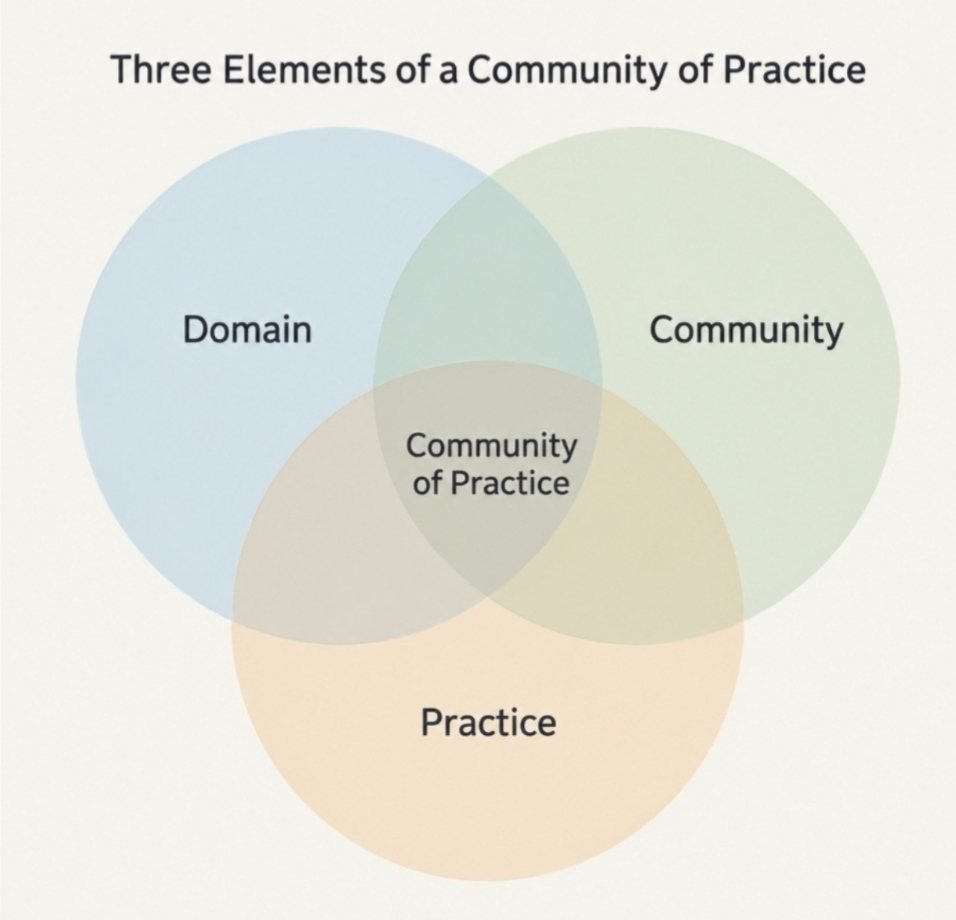
Diagram: QuorumLab, based on Wenger-Trayner (2015).
The diagram shows the framework’s central point: in the Wenger-Trayners’ description, a community of practice requires the combination of all three elements, not any one of them alone.
Can practice become the basis for a real project?
The most surprising thing turned out to be that, in the description of the elements of a community of practice, project-based business activity or activity that leads to financial results is entirely appropriate and does not contradict the model.
The second reason I see this model as effective for a community where participants can not only learn and practise but also earn money by developing their own projects is precisely practice as a fundamental element.
In other words, this is not simply a club of people with shared interests or a place for discussing theory, but also a place for developing a new project, a place where you can find a useful tool and apply it in your work, as well as avoid mistakes, since other participants have quite possibly already encountered similar situations or have examples they can share.
The third reason is learning. The model does not depend on specially organised training courses: it includes learning as part of one of its fundamental elements: Community.
If we look closely, we can see that this learning happens together. And learning together naturally brings people closer at different levels, both personally and professionally. This creates opportunities to build stronger, more trusting relationships, which can become the foundation for financial activity within such a community.

This last point reflects my personal thinking about how practice might lead to financial results.
It is important to note that both the Wenger-Trayners’ examples and my own are based not simply on theory, but on practical knowledge, as I have personally observed these elements in communities. What remains to be explored is an organic path for income-generating projects, whether developed by individual community members or by groups united by a shared domain of interest and practice.
Here I need to distinguish what the source says from what I hope to explore. Wenger-Trayner’s framework describes shared learning and practice. My suggestion that these interactions could lead to paid projects is an additional hypothesis. Learning together does not automatically mean that people will find clients, agree on responsibilities or receive income. Those outcomes would have to be observed and documented separately.
Where does a community find things to do together?
A community of practice finds things to do together in its practice: the Wenger-Trayners list eleven types of activity, from problem solving to mapping knowledge and identifying gaps. I would like to conclude this part by addressing something that raises questions for many people: What will the substance of such a community be? How will content be created? How do we attract people, and what exactly should we do?
These are good questions, and the Wenger-Trayners have already offered some explanations in the paper. In fact, the authors provide more than just answers: they present a table that can help us understand how the mechanism for generating content is already embedded in the practice itself.
The following table preserves the range of activities illustrated in the Wenger-Trayners’ 2015 introduction, but paraphrases their examples rather than reproducing the source table verbatim.
| Activity identified by Wenger-Trayner | What participants might do | What it could contribute |
|---|---|---|
| Problem solving | Discuss a difficult design or work problem. | Exchange approaches to a real task. |
| Requests for information | Ask where to find a relevant technical resource. | Reduce search effort. |
| Seeking experience | Ask who has encountered a similar client situation. | Learn from previous practice. |
| Reusing assets | Adapt an existing proposal or template. | Build on work already done. |
| Coordination and synergy | Explore whether a joint purchase or shared action makes sense. | Coordinate resources. |
| Building an argument | Compare how a problem is handled in different places. | Develop a better-grounded case. |
| Growing confidence | Seek colleagues’ feedback before acting. | Test an idea with peers. |
| Discussing developments | Assess a new professional tool or method. | Interpret change together. |
| Documenting projects | Record a solution to a recurring problem. | Create shared knowledge. |
| Visits | Learn how another group runs an activity. | Transfer practical experience. |
| Mapping knowledge and identifying gaps | Identify expertise within and beyond the group. | Understand missing capabilities. |
Source: Wenger-Trayner & Wenger-Trayner, Communities of Practice: A Brief Introduction (2015), table of example activities. This is a paraphrase, not a report of outcomes from my own communities.
What remains uncertain?
I have personally observed elements of exchange and practical learning in communities, but I have not presented systematic data showing that a particular design produces sustainable commercial projects. To investigate that possibility, I would need to observe whether members continue useful activity without constant organiser-led content, whether they reuse shared resources, and whether actual projects emerge. For commercial projects, evidence would also need to include the participants’ roles, the work completed and the financial outcome.
| Grounded in the cited model | My working hypothesis — not yet established |
|---|---|
| People learn through sustained interaction around a domain. | A community can sustain useful activity with less dependence on its organiser. |
| Members build shared tools and ways of addressing problems. | Some shared resources may support individual or joint paid work. |
| Relationships can develop through participation. | Repeated practical cooperation may make future commercial collaboration easier. |
What conclusion can I draw for now?
I began by asking how to create a community that would not need to be constantly fed by its organiser. I still think the person — the people who participate — is its indispensable element. The Wenger-Trayner model helps me make that intuition more precise: people need a shared domain, relationships and something they actually practise together.
My next question is whether that kind of community can also help participants develop income-generating projects, individually or together. I am not yet ready to call it a finished business-community model. I would rather test the idea in practice, observe what happens over time and allow the definition to change if the evidence requires it.
Frequently asked questions
How is a community of practice different from an online audience?
An audience can gather around one person’s posts, videos or announcements. A community of practice requires more: people share a domain, interact and develop a repertoire of ways of doing things. A platform may host both, but the number of followers does not tell us whether members are learning from one another or building a shared practice.
What do domain, community and practice mean?
Domain is the shared field that gives participants a reason to care. Community refers to relationships and interaction through which they learn together. Practice is what they develop and use: experiences, methods, tools and approaches to recurring problems. In the Wenger-Trayner framework, all three are necessary; one element by itself does not establish a community of practice.
Does a community of practice require formal training?
Not necessarily. Learning can occur as people discuss real problems, compare experiences and improve tools together. That does not mean formal courses are always unnecessary. My interest is in the learning already embedded in practice, which may complement organised teaching. The right balance would depend on the people, their needs and the work they are trying to do.
Can a community of practice help members earn money?
It might, but this is the question I want to research rather than a proven effect of the model. Members could find collaborators or develop useful resources through shared practice. Actual income would depend on customers, agreements, delivery and payment. Those steps cannot be inferred merely from active discussion or stronger relationships within a community.
How could we test whether a community works without its organiser?
We could observe whether members initiate discussions, solve problems, document useful methods and return with results when the organiser contributes less content. Repeated observations would be more informative than a single lively conversation. To test the separate commercial hypothesis, we would also need evidence of real projects and their outcomes, not just expressions of interest.
Sources
- Etienne Wenger-Trayner and Beverly Wenger-Trayner, Communities of Practice: A Brief Introduction, version of 15 April 2015. The three-element framework and the activities table are paraphrased from this publication.